
Case study · Swiggy
How we helped Swiggy turn online frustration into a viral moment of kindness.
What happens when a food delivery giant decides to tackle one of the internet's ugliest problems, online rudeness, with a dash of humour and smart technology? You get "What The Falooda", a browser extension that turned curse words into food names and sparked thousands of social media conversations.
At a glance
Client
Swiggy, India's leading food delivery platform
Industry
FoodTech / Consumer Tech
Challenge
Reducing verbal abuse in customer support
Solution
Cross-browser, bilingual autocorrect extension
Timeline
45 days, concept to public launch
Languages
English and Hindi
About the client
India's food delivery giant.
Since its founding in 2015, Swiggy has transformed how India eats. In less than four years, the company achieved unicorn status. Today, Swiggy serves millions of customers across 500+ cities, partners with 1.6 lakh restaurants, and employs over 2 lakh people, from delivery partners to operations staff to customer support representatives.
With such massive scale comes a unique challenge: managing the emotions of millions of hungry customers, many of whom aren't at their best when their food is late, cold, or missing.
The challenge
The hidden cost of "hanger".
We've all been there. You're starving. Your order is late. The chat window opens, and before you know it, you've typed something you probably shouldn't have. For Swiggy's customer support teams, this scenario plays out hundreds of times a day.
The people absorbing this language aren't the ones who cooked the food or got stuck in traffic. They're support representatives, human beings doing their best to resolve problems. Constant exposure to unkind language takes a toll on employee mental health, and venting frustration rarely solves the problem any faster.
Swiggy wanted to change this dynamic, not through policy enforcement or scolding users, but through something far more powerful: self-awareness and humour.
The solution
Autocorrecting rudeness into smiles.
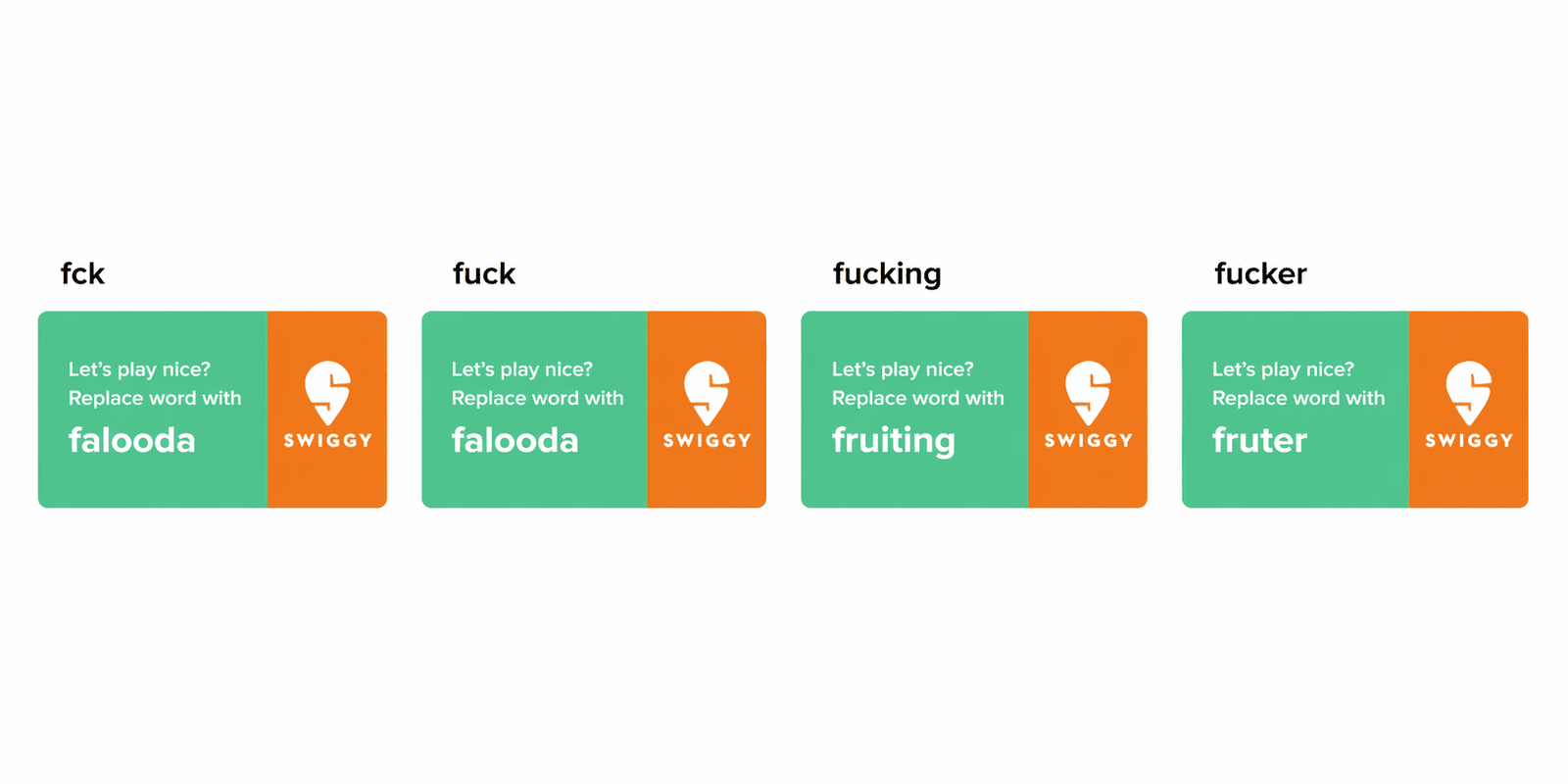
The concept was disarmingly simple: if a user typed a curse word, the extension suggested replacing it with a food item that sounded similar. Users would see their own words reflected back, transformed into something absurd and funny, creating a micro-moment of self-awareness before they hit send.
| What you typed | What it suggested |
|---|---|
| What the f**k?! | What the falooda?! |
| This is s**t! | This is shitake! |
| You idiot! | You idly! |
| Damn it! | Dahi it! |
| A**hole! | Aloo hole! |
Technical execution
Simple concept, complex build.
While the idea was playful, the engineering underneath was anything but trivial. We had 45 days to take this from concept to a fully functional, publicly available browser extension.
01
Cross-browser compatibility
A unified codebase that adapted to Chrome, Firefox, Edge, and Safari, each with its own security architecture and extension framework.
02
Bilingual profanity detection
A flexible matching algorithm trained on English and Hindi profanities, covering spellings, transliterations, tenses, and typos without flooding users with false positives.
03
Privacy-first design
Strict privacy boundaries: the extension can read typed text but never stores, transmits, or logs it. Everything happens locally in the browser.
04
Humour-to-accuracy balance
Multiple rounds of user testing to fine-tune the word mappings, funny enough to disarm frustration, accurate enough to feel intentional.
What we delivered
A small extension, sweating the details.
Cross-platform browser extension
Works on Chrome, Firefox, Edge, and Safari without disrupting the browsing experience.
Bilingual support
Detects and autocorrects profanity in both English and Hindi, including transliterations.
Intelligent variation matching
Recognises different forms, tenses, spellings, and common typos of the same profanity.
Privacy-compliant architecture
All processing happens locally in the browser, no user data is stored or transmitted.
Humorous, brand-aligned substitutions
Each profanity maps to a phonetically similar Indian food item, reinforcing Swiggy's brand identity.
User testing & iteration
Multiple rounds of refinement to land the right balance of humour and accuracy.
The results
A viral conversation starter.
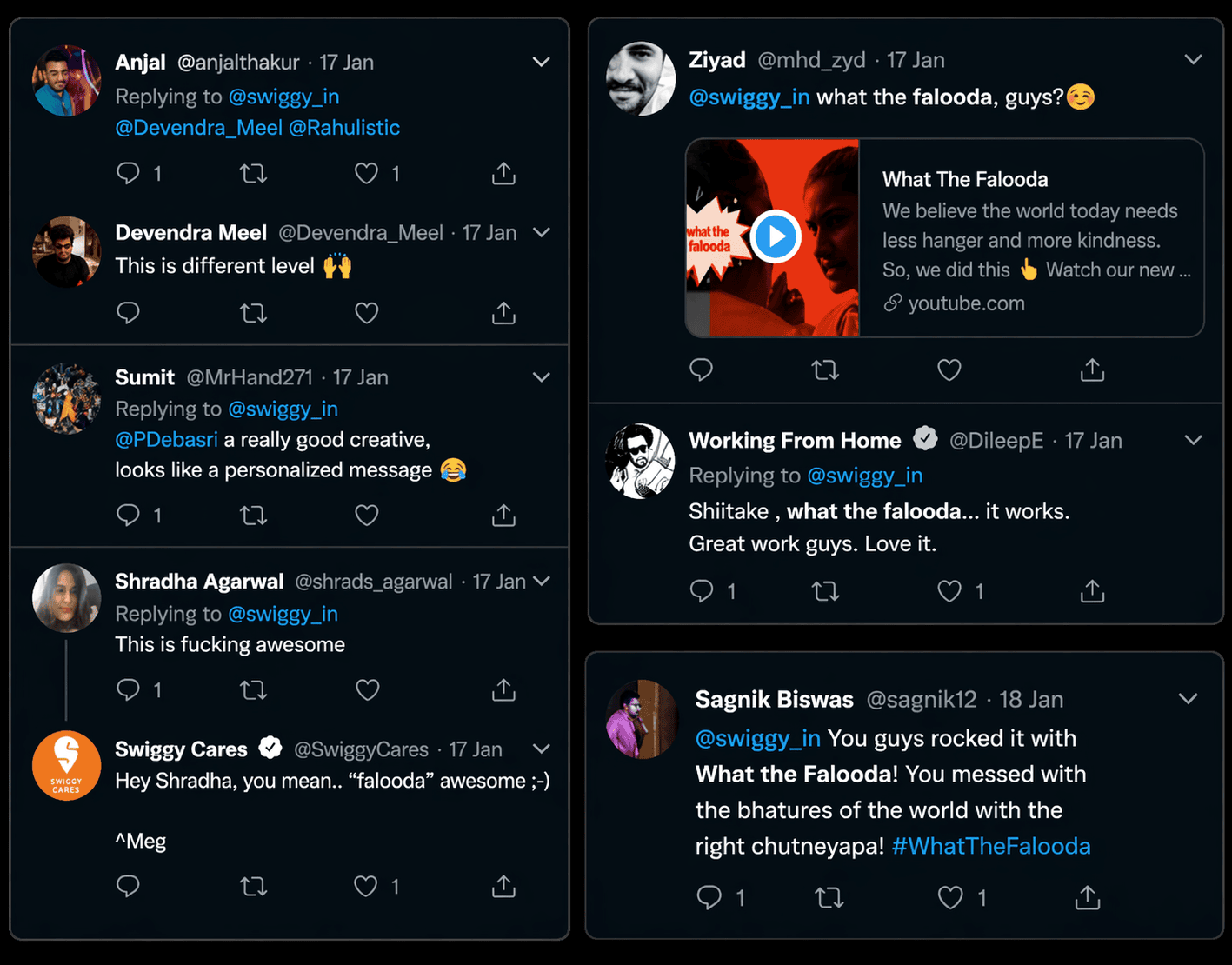
"What The Falooda" launched in late January 2020, and the internet responded with enthusiasm. Thousands of users shared their experiences on Twitter, celebrating the concept and praising Swiggy for addressing a real problem with creativity instead of finger-wagging.
45 days
Concept to public launch
From kickoff to a live, cross-browser extension shipped to the public in just six weeks.
4
Browsers supported
A unified codebase that works seamlessly across Chrome, Firefox, Edge, and Safari.
2
Languages handled
Bilingual profanity detection in English and Hindi, including spellings, tenses, and typos.
Why this matters
When marketing and technology align.
The best marketing campaigns don't just broadcast a message, they create an experience. And the best technology doesn't just function, it changes behaviour. By turning a moment of frustration into a moment of laughter, "What The Falooda" reminded users to be kinder, in a way that felt native to the Swiggy brand.
Have a viral idea worth building?
From marketing tools to customer-facing apps, we help brands and startups bring ambitious ideas to life, on time and on budget.
Book a discovery call